Enemies make life worth living, and increases profits particularly where the exploited enemy is less powerful. Where a distraction is needed, or justification for exploitation, name the subjugated persons as an enemy -- of cultural values that shall not be questioned. Test the theory. We offer here a timeline of British heritage and its once-colony, America, adopting how "enemies" language, manipulates , justifies and targets. Movements in history have been, as now, steered by labels of "enemy" or "opposition" rather than simple disagreements between sides, each with merit. Where immediate substantive change is called for by those in charge, watch for increasingly extreme characterizations and dependence on the enemy concept rather than merit. Force works.
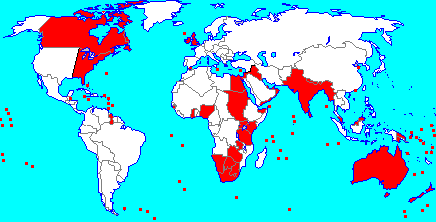
British Colonial Timeline.
Who Owns England (countryfile site)
The Dark Ages to 1066
Trans-Atlantic Slave Trade Timeline
Civil Rights Law Timeline
Transgender Rights Timeline
Gender Equality Timeline, Australia 1882-date
Women's Rights Timeline US 1769-date
Labor History Timeline to 1999
Workers' Rights Timeline
Labor Movement AFL-CIO and Gender Equality, Immigrant , Safety, Civil, Workplace, Retirement, and Shared Prosperity Rights etc.
Viking Timeline; Russia Timeline; Mongol Timeline. And on with Persia, Egypt, Arabia, Africa
Main focus for Britain in the Timeline:
a) http://projectbritain.com/history.html; and
b) https://www.countryfile.com/news/who-owns-england-history-of-englands-landownership-and-how-much-is-privately-owned-today/
The result: the colonized often internalize inferiority as a judgement upon them. And the fomenting of rebellion. Watch walls against opportunity, dignity, infliction of violence. Something doesn't love a wall -- against self sustenance, against exploitation, against movement, that wants it down. Robert Frost. Mending Wall.
A. External colonizers
Page
43 Roman Britain
======================================
B. Colonizing its own
1249-1286 -- Scotland is ruled by Alexander III, need info here, whose wife was Margaret of England; faction issues, then emerging as a golden age for Scots nationalism later?
1249-1260 -- "Interregnum". Charles I was executed. See Stuart timeline at 1603 below, Sites differ on details here, but the point is ongoing conflicts for control, who can colonize whom.
1371 -- Stuarts rule in Scotland and to 1714
1485 -- Tudor Britain.
C. Global Reach
1603 Stuart Britain
I. Britain and America Timeline Sources here:
Who is the identified enemy in each case: The group seeking a voice.
British Colonial Timeline.
Who Owns England (countryfile site)
The Dark Ages to 1066
Trans-Atlantic Slave Trade Timeline
Civil Rights Law Timeline
Transgender Rights Timeline
Gender Equality Timeline, Australia 1882-date
Women's Rights Timeline US 1769-date
Labor History Timeline to 1999
Workers' Rights Timeline
Labor Movement AFL-CIO and Gender Equality, Immigrant , Safety, Civil, Workplace, Retirement, and Shared Prosperity Rights etc.
Viking Timeline; Russia Timeline; Mongol Timeline. And on with Persia, Egypt, Arabia, Africa
Main focus for Britain in the Timeline:
a) http://projectbritain.com/history.html; and
b) https://www.countryfile.com/news/who-owns-england-history-of-englands-landownership-and-how-much-is-privately-owned-today/
II. Colonialism as abuse. Indigenous as enemies.
The colonizers are good and inherently superior.
Those objecting to colonization are bad and inferior.; disposable people
The result: the colonized often internalize inferiority as a judgement upon them. And the fomenting of rebellion. Watch walls against opportunity, dignity, infliction of violence. Something doesn't love a wall -- against self sustenance, against exploitation, against movement, that wants it down. Robert Frost. Mending Wall.
- Examples --
- DRC (Congo),
- The Philippines; including a thesis noting Spanish domination inning 1521, and American 1898-1946 officially) d ive and necessity to migrate away from a negative environment, https://www.sciencedirect.com/science/article/abs/pii/S0169534711002072.
- India;
III. Britain and American history. The cycle of enemies. Cycle of abuse.
A. Britain colonized by Rome, Vikings and Normans;
B. Britain colonizer of its Isle neighbors-- Scotland, Wales, Ireland
C. Britain global reach, economic exploitation from Americas, Caribbean and Africa to Far East
D. America the colonized, colonizes others; ongoing corporate strangleholds.
A. External colonizers
Page
43 Roman Britain
- Feudal system, peasants worked land and gave most to lord in exchange for protection and so on, commons for grazing, growing, freemen also, another topic, see https://www.historyofengland.net/kings-and-queens/the-dark-ages-450-1066-introduction
Go to the countryfile or ProjectBritain site sfor the full coverage:
793 Viking Britain
1066
Medieval Britain. Norman Conquest. William the Conqueror invades
Saxon England
from Normandy (the Normans, or "Northmen" had settled there, the French
desiring to rid themselves of raiding Vikings and giving them the land,
apparently
- William the Conqueror moved to concentrate Britain's land in the new Norman elite, https://www.countryfile.com/news/who-owns-england-history-of-englands-landownership-and-how-much-is-privately-owned-today. William declared all land to belong to the Crown;. He handed it out to favored groups: church and barons etc. retaining an "estate" for the monarchy. Countryfile. Fast forward to that site for how much of current land ownership stems from a thousand years ago.
======================================
B. Colonizing its own
1249-1286 -- Scotland is ruled by Alexander III, need info here, whose wife was Margaret of England; faction issues, then emerging as a golden age for Scots nationalism later?
1249-1260 -- "Interregnum". Charles I was executed. See Stuart timeline at 1603 below, Sites differ on details here, but the point is ongoing conflicts for control, who can colonize whom.
1371 -- Stuarts rule in Scotland and to 1714
1485 -- Tudor Britain.
- Henry Tudor wins Battle of Bosworth against Richard III. Henry (now the VII ) is crowned.
- Henry VIII takes much land of the church, Countryfile
C. Global Reach
1603 Stuart Britain
- James I Rule. Scotland and England and Ireland as one country [James I then called himself King of Great Britain]
- Massachusetts beomes British colony.
- 1622 ff-- Maine and Virginia become British Colonies;
- 1623 -- New Hampshire as British Colony. See chart at https://www.britishempire.co.uk/timeline/colonies.htm below the interactive map of incremental involvements around globe beginning early 1600's to status 20th Century
- 1625 -- Barbados becomes British colony (or 1627?) .
Progression of control, exploitation
1629 -- Charles I dissolves parliament and begins personal rule
1642-1652 -- Political dissenters, a small movement, the Diggers and the Levellers, emerge. See
https://libcom.org/history/1642-1652-diggers-levellers
A leader of the Diggers: Charles Winstanley, Earth as "common treasury for all"
1642 -- Royalists (a/k/a Cavaliers) v. Parliamentarians (a/k/a Roundheads) begins. Charles I at Nottingham raises his standard. Then battle. Parliamentarians had some advantages: authority over the navy, and financial resources.
1645. Enter Oliver Cromwell and Thomas Fairfax. Oliver Cromwell forms the 'New Model Army,' Defeats Royalist army led by King Charles I, Battle of Naseby.
Execution of King Charles I
1651 -- Charles II is crowned king of Scotland but is defeated by Cromwell at Battle of Worcester
1652 -- "Law of Freedom in a Platform" is published, by the Levellers. See text, context at http://www.bilderberg.org/land/lawofree.htm. Then, Oliver Cromwell's response,
1653 -- Oliver Cromwell becomes Lord Protector (powers similar to monarch, and with army support), conquers Ireland and Scotland
1660 -- Restoration of the monarchy: King Charles II
1664 -1665 -- Great Plague. London. 100,000 people dead. In one year, 1/2 of the city population was dead.
1666 -- Great Fire, London. Destroyed 2/3 of the city.
1685 -- Charles II dies and James II becomes King. James II suspends parliament tries to return England to Catholicism.
1688-89 -- Revolution in England. James II is overthrown, throne now to William of Orange (William II), whose wife was Mary II
1707 -- England and Scotland become one country
1714 Georgian Britain -- The Stuarts no longer rule in Scotland or England
1715 -- End of Stuarts. House of Hanover enters. The daughter of James I had married Elector Frederick V and her descendants then became House of Hanover that took over after the Stuarts.
1739 -- Ship load(s) of Scots captured to be slaves, similar to impressment, with no time limit, and from the Isle of Skye and other islands of the Hebrides were sent to the Caribbean. See https://www.scotsman.com/whats-on/arts-and-entertainment/hebridean-slaves-offered-aps3-head-866404. See also Dunvegan Castle, Isle of Skye, Hebrides Road Ways. Some Black surnames still reflect those early Scots roots. Check it out. Is Hartford's delicious Scott's Jamaican Bakery connected to that history? See https://www.seamless.com/menu/scotts-jamaican-bakery-1344-albany-avenue-hartford/1593368
1745 - Bonnie Prince Charlie, Charles Edward Stuart, defeated at Culloden , https://www.thoughtco.com/bonnie-prince-charlie-4766631; fled by boat to Isle of Skye, disguised as a woman
====================================================
D. American adoptions
1769 -- US adopts British law. Women cannot own property in their own name,
1776 -- American colony, July 4 Declaration of Independence
1777 -- All US states enact laws preventing women from the vote
1794 -- Right to Strike is established for workers in US
1837 Victorian Britain
1839 - Mississippi allows women to own property with permission of the husband
1849 - Seneca Falls signing of "Declaration of Sentiments" promoting rights of women
1862 -- England. Land Registry established; modern day -- 17% still unregistered. See https://www.countryfile.com/news/who-owns-england-history-of-englands-landownership-and-how-much-is-privately-owned-today/
Developing: Land reforms: County farms, council homes. Statutory right to an allocation of land to grow food, and council homes were built (locally owned residence buildings some including shops in the community.
1866 -- Fourteenth amendment is passed, with citizen and voters declared to be male in Constitution
1873 -- England. A second "Domesday" book census registry shows some 4,000 "lords and gents" own half of England, Countryfile A system of County Farms is established, a "statutory right :to an allocation of land for growing food, Countryfile. Council houses are built, a local authority-owned community for housing, including some shops/ [By 2015, much had been sold offl
Industrialists buying.
1890 -- Wyoming gives women right to vote. The enemy comes home to roost
1900 -- By this time, all states grant women right to keep own wages and own property
1902 Modern Britain
1905 --Elsewhere. Russia. Read workers' petition. Bloody Sunday, Russian Revolution trigger, St. Petersburg, Petition. https://russiaroadwaysstpetersburg.blogspot.com/2016/04/bloody-sunday-1905-workers-petition-what-was-wanted-why-the-slaughter-at-that-time-in-that-manner.html
1914 -- England. Only some 3% of land remains for use as enclosed commons
1918 - Margaret Sanger in Brooklyn NY opens clinic, gains right for doctors to advise married women on birth control for health reasons. Clinic becomes Planned Parenthood in 1942
1919 -- British Timber shortage, result of military acquisitions, war activities, testing, materiel
1923 -- US First version of an Equal Rights Amendment introduced
1932 ---US Recovery Act requires that only one family member can hold a governemnt job; many women lose employment
Post WWII -- British Planning on the rise - building projects etc.
1942 - US Planned Parenthood established in Brooklyn, see 1918
1963 -- US Equal Pay Act passed; 1964 Title VII of Civil Rights Act passed; 1965 Supreme Court gives right for married women to use contraception; 1968 no government discrimination and affirmative action for hiring women; 1972 Title IX Civil Rights no sex discrimination in federally funded education programs; and etc. at https://www.usnews.com/news/the-report/articles/2017-01-20/timeline-the-womens-rights-movement-in-the-us
1979 -- Britain. Publicly owned projects, council housing, sold off increasingly
1994 -- Britain. Council housing: Social homes. at some 3.67 million https://www.mirror.co.uk/news/uk-news/revealed-how-many-council-homes-7853057
2000 -- British Right to Roam. See "Countryside and Rights of Way Act" Countryfile. Also "Right to Buy" from absentee landowners particularly Scots
2003 -- Britain Home ownership at max level 72%, then decline
2015 -- Britain Council housing down to some 1.64 million. Mirror. Many passed to "private registered providers" now some 2.45 million of those.
IV. Semi-Conclusions
On the humor side, that appears to lead to a British, and now-American, tradition to demonize the opposition, which in turn creates more enemies. See British Visual Satire. And more political cartoons, https://hyperallergic.com/215857/political-cartoons-from-a-golden-age-of-british-satire/
Enemies Theory, as shown in British-American political timelines..
- from colonies
- to dominions
- to protectorates
- to mandates
- to independence
1629 -- Charles I dissolves parliament and begins personal rule
1642-1652 -- Political dissenters, a small movement, the Diggers and the Levellers, emerge. See
https://libcom.org/history/1642-1652-diggers-levellers
- Diggers and Levelers Theme: opposed private ownership of land, use for the common good. This was the era of King Charles I who ruled 1625-1649 (executed). This small and unsuccessful movement was part of the larger context of an English Civil War. Find them at https://libcom.org/history/1642-1652-diggers-levellers. They lost, but their ideas recurred: rights to food, to grow crops, to ramble, to transfer land from the A's to the B's, which usually did not last long.
- Countryfile. Diggers and Levelers opposed the 'slavery of property,' advocate a classless society, secularism, 'radical democracy,' without force, but by seizure of land (is that not force?), and ownership ior the common good. They take control of land in Surrey and grow corn etc, for just over a year, and expand into Northamptonshire and Kent, angering army, landlords and against the "law."
A leader of the Diggers: Charles Winstanley, Earth as "common treasury for all"
“When men take to buying and selling the land, saying ’This is mine’, they restrain other fellow creatures from seeking nourishment from mother earth…..so that he that had no land was to work for those, for small wages, that called the land theirs; and thereby some are lifted up into the chair of tyranny and others trod under the footstool of misery, as if the earth were made for a few and not for all men.” https://libcom.org/history/1642-1652-diggers-levellersGroup makeup: Petty bourgeoisie, shopowners, tradesmen, skilled workers, peasants. Libcom.org.
1642 -- Royalists (a/k/a Cavaliers) v. Parliamentarians (a/k/a Roundheads) begins. Charles I at Nottingham raises his standard. Then battle. Parliamentarians had some advantages: authority over the navy, and financial resources.
- Parliamentarians do not appear to be the tradesmen, skilled workers peasants. They appear to be the emerging oligarchs, wealthy of town and country
1645. Enter Oliver Cromwell and Thomas Fairfax. Oliver Cromwell forms the 'New Model Army,' Defeats Royalist army led by King Charles I, Battle of Naseby.
Execution of King Charles I
1651 -- Charles II is crowned king of Scotland but is defeated by Cromwell at Battle of Worcester
1652 -- "Law of Freedom in a Platform" is published, by the Levellers. See text, context at http://www.bilderberg.org/land/lawofree.htm. Then, Oliver Cromwell's response,
1653 -- Oliver Cromwell becomes Lord Protector (powers similar to monarch, and with army support), conquers Ireland and Scotland
1660 -- Restoration of the monarchy: King Charles II
1664 -1665 -- Great Plague. London. 100,000 people dead. In one year, 1/2 of the city population was dead.
1666 -- Great Fire, London. Destroyed 2/3 of the city.
1685 -- Charles II dies and James II becomes King. James II suspends parliament tries to return England to Catholicism.
1688-89 -- Revolution in England. James II is overthrown, throne now to William of Orange (William II), whose wife was Mary II
1707 -- England and Scotland become one country
1714 Georgian Britain -- The Stuarts no longer rule in Scotland or England
1715 -- End of Stuarts. House of Hanover enters. The daughter of James I had married Elector Frederick V and her descendants then became House of Hanover that took over after the Stuarts.
1739 -- Ship load(s) of Scots captured to be slaves, similar to impressment, with no time limit, and from the Isle of Skye and other islands of the Hebrides were sent to the Caribbean. See https://www.scotsman.com/whats-on/arts-and-entertainment/hebridean-slaves-offered-aps3-head-866404. See also Dunvegan Castle, Isle of Skye, Hebrides Road Ways. Some Black surnames still reflect those early Scots roots. Check it out. Is Hartford's delicious Scott's Jamaican Bakery connected to that history? See https://www.seamless.com/menu/scotts-jamaican-bakery-1344-albany-avenue-hartford/1593368
1745 - Bonnie Prince Charlie, Charles Edward Stuart, defeated at Culloden , https://www.thoughtco.com/bonnie-prince-charlie-4766631; fled by boat to Isle of Skye, disguised as a woman
====================================================
D. American adoptions
1769 -- US adopts British law. Women cannot own property in their own name,
1776 -- American colony, July 4 Declaration of Independence
1777 -- All US states enact laws preventing women from the vote
1794 -- Right to Strike is established for workers in US
1837 Victorian Britain
1839 - Mississippi allows women to own property with permission of the husband
1849 - Seneca Falls signing of "Declaration of Sentiments" promoting rights of women
1862 -- England. Land Registry established; modern day -- 17% still unregistered. See https://www.countryfile.com/news/who-owns-england-history-of-englands-landownership-and-how-much-is-privately-owned-today/
Developing: Land reforms: County farms, council homes. Statutory right to an allocation of land to grow food, and council homes were built (locally owned residence buildings some including shops in the community.
1866 -- Fourteenth amendment is passed, with citizen and voters declared to be male in Constitution
1873 -- England. A second "Domesday" book census registry shows some 4,000 "lords and gents" own half of England, Countryfile A system of County Farms is established, a "statutory right :to an allocation of land for growing food, Countryfile. Council houses are built, a local authority-owned community for housing, including some shops/ [By 2015, much had been sold offl
Industrialists buying.
1890 -- Wyoming gives women right to vote. The enemy comes home to roost
 Old print. Dominance does not last. The abused will return.
1900 -- By this time, all states grant women right to keep own wages and own property
1902 Modern Britain
1905 --Elsewhere. Russia. Read workers' petition. Bloody Sunday, Russian Revolution trigger, St. Petersburg, Petition. https://russiaroadwaysstpetersburg.blogspot.com/2016/04/bloody-sunday-1905-workers-petition-what-was-wanted-why-the-slaughter-at-that-time-in-that-manner.html
1914 -- England. Only some 3% of land remains for use as enclosed commons
1918 - Margaret Sanger in Brooklyn NY opens clinic, gains right for doctors to advise married women on birth control for health reasons. Clinic becomes Planned Parenthood in 1942
1919 -- British Timber shortage, result of military acquisitions, war activities, testing, materiel
1923 -- US First version of an Equal Rights Amendment introduced
1932 ---US Recovery Act requires that only one family member can hold a governemnt job; many women lose employment
Post WWII -- British Planning on the rise - building projects etc.
1942 - US Planned Parenthood established in Brooklyn, see 1918
1963 -- US Equal Pay Act passed; 1964 Title VII of Civil Rights Act passed; 1965 Supreme Court gives right for married women to use contraception; 1968 no government discrimination and affirmative action for hiring women; 1972 Title IX Civil Rights no sex discrimination in federally funded education programs; and etc. at https://www.usnews.com/news/the-report/articles/2017-01-20/timeline-the-womens-rights-movement-in-the-us
1979 -- Britain. Publicly owned projects, council housing, sold off increasingly
1994 -- Britain. Council housing: Social homes. at some 3.67 million https://www.mirror.co.uk/news/uk-news/revealed-how-many-council-homes-7853057
2000 -- British Right to Roam. See "Countryside and Rights of Way Act" Countryfile. Also "Right to Buy" from absentee landowners particularly Scots
2003 -- Britain Home ownership at max level 72%, then decline
2015 -- Britain Council housing down to some 1.64 million. Mirror. Many passed to "private registered providers" now some 2.45 million of those.
- See Countryfile site or tally now, https://www.countryfile.com/news/who-owns-england-history-of-englands-landownership-and-how-much-is-privately-owned-today/-- huge swaths owned by Crown and lords and gents etc. Really good pie chart there for the components -- church, new money, crown,charity, etc and only 5% homeowners.
- Aristocrats and gentry own 30% of England. Enter foreign wealth, Arab, Russian, oligarchs, corporations own 18% of England and Wales, see offshore tax havens
IV. Semi-Conclusions
On the humor side, that appears to lead to a British, and now-American, tradition to demonize the opposition, which in turn creates more enemies. See British Visual Satire. And more political cartoons, https://hyperallergic.com/215857/political-cartoons-from-a-golden-age-of-british-satire/
- These illustrations, from a family old framed print, had no caption. We suggest women's rights, for example, as women who challenged the status quo became an enemy ; while laws excluded ladies from property and voting. What political statement is suggested here?
 Political statements through cartoon. What is the history here. Why the abuse. Who is or was the abuser, the abused, and what is next.
Enemies Theory, as shown in British-American political timelines..
- One theory for the success of creating and identifying enemies, in order to conceal one's own shortcomings, is that pointing to enemies make life safer for the one who buy into the theory,
- A handy enemy provides an immediate focal point for emotion and anger. See Psychology Today. (below)
- Why does this matter? It matters because colonial mindsets create enemies in the indigenous culture just out of force.
- Enemies as a mindset hinders the progress a culture can otherwise make to solve mutual problems. Perhaps the colonizer could care less.
- Yet, making enemies is short-sighted. Emotions for retaliation and compensation once fanned, persist.
- Change under the guise of democracy has been hindered from the start by the simplest of stalling tactics: name an enemy.
- Blame someone or something. Anything but find fault with established entitlements entrenched in law and mind. The ide aof enemies theory was first found in Psychology Today in a modest article at https://www.psychologytoday.com/us/blog/the-big-questions/201110/enemies-enhance-the-meaning-life h
- If that is so, that it is enemies that enhance the meaning of life, that there is something natural in the dominion response, what next? Spoiler: The focus should be not on the sad state of inbred victimization, but on economics and justice.
- Historical dissent against economic and justice abuses are part of our fabric, not recent fabrications as "communist" or "socialist." TIt just may be time to can the enemies idea and solve the problems. Bring on justice and economic parity with opportunity.
- Here: polarized dissent against dictatorship in high places:
- Parliamentarians against Royalists.
- But too many Parliamentarians were also oligarchs, boasting land grants from William the Conqueror.
- Full circle of dysfunction and insulation against having to be just and share the benefits of labor.
- And Catholic against Protestant, and all against Jews. Religion ran from duties to others and sharing; to adopted enemies -- who defied the new catechism, who shall be brought before the inquisitors, who dares question the institution.
No comments:
Post a Comment